features
Optical illusion and its consequences
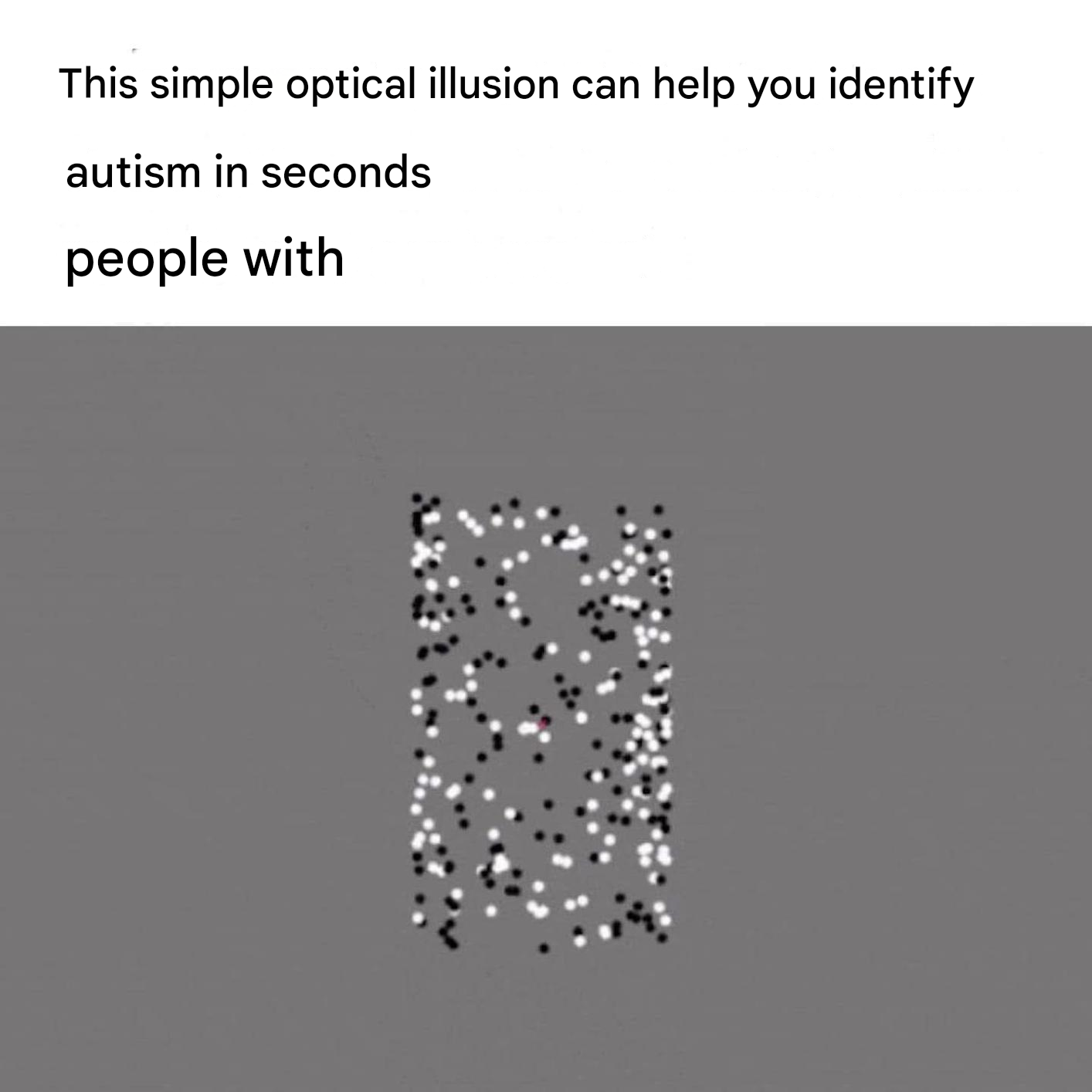
The optical illusion studied consists of black and white dots, which can be seen as two independent, oppositely moving sheets or a rotating column. This experiment allows researchers to compare the perceptual and cognitive processes of people with and without autism spectrum disorder (ASD). If we see the dots as two separate, moving sheets, it is because we focus first on one color and then on the other. We identify them as unique features of unrelated scenes – a very detail-oriented perspective.
If you observe the illusion as a rotating column, you get a better idea of it and recognize it as a single system. One shade (probably white) appears as the beginning of a dot that travels across the surface of the column before turning over the edge, revealing the second shade (black) on the inner surface. While you may be able to switch back and forth to see both, people whose brains reflect characteristics associated with autism spectrum disorder (ASD) will typically see it as two moving sheets. Again, interpreting it this way does not necessarily mean you have autism.
The study
The researchers conducted a study with 50 people who were not diagnosed with autism spectrum disorder (ASD). Instead of asking the subjects what they saw, the researchers focused on their eyes. When they focused on each layer separately, their pupils flickered as they adjusted to the two different shades of light. The subjects then completed a questionnaire to determine the presence of other characteristics and traits associated with autism.
You can find the continuation on the next page.
Publicité